Now a third one of Darwin's great contributions was that he replaced theological, or supernatural, science with secular science. Laplace, of course, had already done this some 50 years earlier when he explained the whole world to Napoleon. After his explanation, Napoleon replied, "where is God in your theory?" And Laplace answered, "I don't need that hypothesis." Darwin's explanation that all things have a natural cause made the belief in a creatively superior mind quite unnecessary. He created a secular world, more so than anyone before him. Certainly many forces were verging in that same direction, but Darwin's work was the crashing arrival of this idea and from that point on, the secular viewpoint of the world became virtually universal.
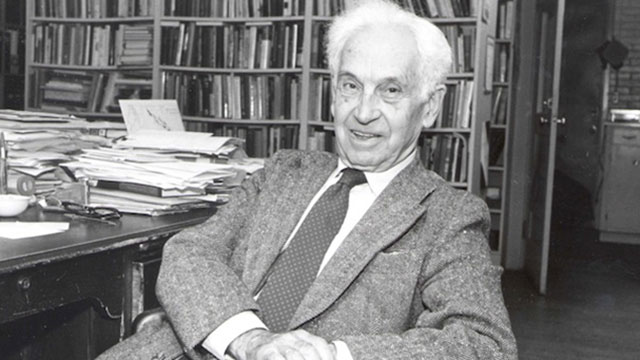
ERNST MAYR is Alexander Agassiz Professor of Zoology, Emeritus, at Harvard University. He is the recipient of numerous honorary degrees and awards, including the National Medal of Science, the Balzan Prize, and the Japan Prize.
Mayr is one of the 20th century's leading evolutionary biologists. His work has contributed to the conceptual revolution that led to the synthesis of Mendelian genetics and Darwinian evolution, and to the development of the biological species concept. His theory of peripatric speciation has become widely accepted as one of the standard modes of speciation, and is the basis of the theory of punctuated equilibrium. Furthermore, his writings reflect, not only a technical expertise in biological subjects, but also a broad and penetrating understanding of the deeper philosophical issues involved.
Among his many books are Animal Species and Evolution; Evolution and the Diversity of Life; Systematics and the Origin of Species; The Growth of Biological Thought; One Long Argument; Population, Species, and Evolution; This Is Biology; and Toward a New Philosophy of Biology.
Mayr, born Kempten, Germany in 1904, began his studies of ornithology at the University of Berlin where, in June, 1926, at the age of 21, he received his Ph.D. In June, 2001, to honor the 75th anniversary of this event, the Humboldt University of Berlin awarded him a second (and honorary) Ph.D. Ernst Mayr's Edge Bio Page
INTRODUCTION
by Jared Diamond
When the first bird survey of the Cyclops Mountains was carried out. I found it hard to imagine how anyone could have survived the difficulties of that first survey of 1928, considering the already-severe difficulties of my second survey in 1990.
That 1928 survey was carried out by the then-23-year-old Ernst Mayr, who had just pulled off the remarkable achievement of completing his Ph.D. thesis in zoology while simultaneously completing his pre-clinical studies at medical school. Like Darwin, Ernst had been passionately devoted to outdoor natural history as a boy, and he had thereby come to the attention of Erwin Stresemann, a famous ornithologist at Berlin's Zoological Museum. In 1928 Stresemann, together with ornithologists at the American Museum of Natural History in New York and at Lord Rothschild's Museum near London, came up with a bold scheme to "clean up" the outstanding remaining ornithological mysteries of New Guinea, by tracking down all of the perplexing birds of paradise known only from specimens collected by natives and not yet traced to their home grounds by European collectors. Ernst, who had never been outside Europe, was the person selected for this daunting research program.
Ernst's "clean-up" consisted of thorough bird surveys of New Guinea's five most important north coastal mountains, a task whose difficulties are impossible to conceive today in these days when bird explorers and their field assistants are at least not at acute risk of being ambushed by the natives. Ernst managed to befriend the local tribes, was officially but incorrectly reported to have been killed by them, survived severe attacks of malaria and dengue and dysentery and other tropical diseases plus a forced descent down a waterfall and a near-drowning in an overturned canoe, succeeded in reaching the summits of all five mountains, and amassed large collections of birds with many new species and subspecies. Despite the thoroughness of his collections, they proved to contain not a single one of the mysterious "missing" birds of paradise. That astonishing negative discovery provided Stresemann with the decisive clue to the mystery's solution: all of those missing birds were hybrids between known species of birds of paradise, hence their rarity.
From New Guinea, Ernst went on to the Solomon Islands in the Southwest Pacific, where as a member of the Whitney South Sea Expedition he participated in bird surveys of several islands, including the notorious Malaita (even more dangerous in those days than was New Guinea). A telegram then invited him to come in 1930 to the American Museum of Natural History in New York to identify the tens of thousands of bird specimens collected by the Whitney Expedition on dozens of Pacific Islands. Just as Darwin's "explorations," sitting at home, of collections of barnacles were as important to Darwin in forming his insights as was his visit to the Galapagos Islands, so too Ernst Mayr's "explorations" of bird specimens in museums were as important as his fieldwork in New Guinea and the Solomons in forming his own insights into geographic variation and evolution. In 1953 Ernst moved from New York to Harvard University's Museum of Comparative Zoology, where even today he continues to work at the age of 97, still writing a new book every year or two. For scholars studying evolution and the history and philosophy of biology, Ernst's hundreds of technical articles and dozens of technical books have been for a long time the standard reference works.
But in addition to gaining insights from his own fieldwork in the Pacific and from his own studies of museum bird specimens, Ernst has collaborated with many other scientists to extract insights from other species, ranging from flies and flowering plants to snails and people. One of those collaborations transformed my own life, just as the meeting with Erwin Stresemann transformed Ernst's life. While I was a teenaged schoolboy, my father, a physician studying human blood groups, collaborated with Ernst in the first study proving that human blood groups evolve subject to natural selection. I thereby met Ernst at dinner at my parents' house, was later instructed by him in the identification of Pacific island birds, began in 1964 the first of 19 ornithological expeditions of my own to New Guinea and the Solomons, and in 1971 began to collaborate with Ernst on a massive book about Solomon and Bismarck birds that we completed only this year, after 30 years of work. My career, like that of so many other scientists today, thus exemplifies how Ernst Mayr has shaped the lives of 20th-century scientists: through his ideas, his writings, his collaborations, his example, his lifelong warm friendships, and his encouragement.
— Jared Diamond
[Excerpted from Jared Diamond's Introduction to What Evolution Is by Ernst Mayr — Science Masters Series /Basic Books; October 2001]