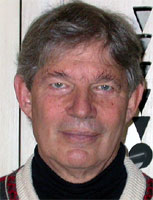
For the last ten or fifteen years, I've been trying to understand situations in nature in which the genes within a single individual are in disagreement—or put differently, in which genes within an individual are selected in conflicting directions. It's an enormous topic, which 20 years ago looked like a shadow on the horizon, just as about a hundred years ago what later became relativity theory was just two little shadows on the horizon of physics, and blew up to become major developments. In genetics it's fair to say that about 20 years ago a cloud on the horizon was our knowledge that there were so-called selfish genetic elements in various species that propagated themselves at the expense of the larger organism. What was then just a cloud on the horizon is now a full-force storm with gale winds blowing.
—Robert Trivers

For the past several years Edge has hosted an annual end-of-summer event. As a departure, this year's event was organized around the work of one person: the legendary Robert Trivers. It was held in Cambridge, on September 7-8 at The Program for Evolutionary Dynamics at Harvard University.
The event began with a reception and dinner on September 7th for Trivers, a group of Edge regulars, and friends of Nowak's Institute. The following day featured five talks: Robert Trivers began the program with a talk on "New Work on Selfish Genetic Elements", and ended the proceedings with his long-standing ideas on "Deceit and Self-Deception". J. Craig Venter spoke about "Ocean Genomics"; Seth Lloyd on "The Computational Universe"; and Martin Nowak on "The Evolution of Cooperation."
Participants included: Daniel C. Dennett, Alan Dershowitz, Jeffrey Epstein, Nancy Etcoff, Peter Galison, Daniel Gilbert, Alan Guth Marc D. Hauser, Seth Lloyd, Marvin Minsky, Andrew Murray, Martin Nowak, Steven Pinker, Lisa Randall, Lee Smolin, Liz Spelke, Lawrence Summers, Robert Trivers, J. Craig Venter, Dan Wegner, E.O. Wilson.
This online presentation is a reprise of the live program in Cambridge with an added introduction, comments on the work of Trivers by Steven Pinker, and a talk with Trivers in July which inspired the program. Edge plans to publish the edited talks, video clips, and discussions over the next few months along with Reality Club discussions among speakers, participants, and the wider Edge community. The line-up is as follows:
Introduction by John Brockman (below)
Steven Pinker on Robert Trivers (below)
Robert Trivers: "A FULL-FORCE STORM WITH GALE WINDS BLOWING" (below)
Robert Trivers: "NEW WORK ON SELFISH GENETIC ELEMENTS" (to come)
J. Craig Venter: "OCEAN GENOMICS " (to come)
Seth Lloyd: "THE COMPUTATIONAL UNIVERSE" (to come)
Martin Nowak: "THE EVOLUTION OF COOPERATION" (to come)
Robert Trivers: "DECEIT AND SELF-DECEPTION" (to come)


We are devoted to researching every possible application of Mathematics and Computer Science to Biology. At the center of a quantitative approach to biology is evolutionary theory as pioneered by Charles Darwin. Concepts of evolutionary biology can be formulated in terms of mathematical equations describing mutation and selection of replicating individuals. We have active research projects on the evolutionary dynamics of infectious agents, cancer cells, altruistic behavior, and human language.
The Program for Evolutionary Dynamics was established in 2003 by Harvard University President Lawrence H. Summers following an imaginative proposal by Jeffrey Epstein and Benedict Gross. The center operates under the auspices of William Kirby, Dean of the Faculty of Arts and Sciences. Martin Nowak, Professor of Mathematics and Biology, is the Faculty Director.
ROBERT TRIVERS: An Edge Special Event — Co-hosted by The Program for Evolutionary Dynamics at Harvard University, Martin Nowak, Director
Introduction
Thirty years ago, Robert Trivers disappeared.
My connection to him is goes back to the 1970s. He had left Harvard and was roaming around Santa Cruz when I was introduced to him in a telephone call by our mutual friend Huey P. Newton, Chairman of The Black Panther Party. Huey put Robert on the phone and we had a conversation in which he introduced me to his ideas. I recall noting at the time the power and energy of his intellect. Huey, excited by Robert's ideas on deceit and self-deception, was eager for the three of us to get together.
We never had the meeting. Huey met a very bad end. I lost track of Robert. Over the years there were rumors about a series of breakdowns; he was in Jamaica; in jail.
He fell off the map.
But during his thirty year disappearance, the influence of his ideas has grown and transcended the purely scientific arena. And through all his ups and downs, he never stopped working on his theories.
Several weeks ago, I traveled to Vienna to visit with the mathematician Karl Sigmund, Martin Nowak's early advisor, long-time colleague, and collaborator. Karl and I talked about theories of indirect reciprocity, generous reciprocity, reputation, and assessment, and the relevance of these concepts in our everyday lives.
"Where did you come up with these ideas?" I asked Karl.
"In the early 70s," he said. "I read a famous paper by Robert Trivers, one of five he wrote as a graduate student at Harvard, in which the idea of indirect reciprocity was mentioned obliquely. He spoke of generalized altruism, where you are giving back something not to the person you owed it to but to somebody else in society. This sentence suggested the possibility that generosity may be a consideration of how altruism works in evolutionary biology."
Karl went on to explain how evolutionary concepts of indirect reciprocity, generous reciprocity, reputation assessment, cooperation, evolutionary dynamics—all inspired by Trivers' early paper—are very much in play in all our lives: in Google's page rankings; in amazon.com's reader reviews; in the reputations of eBay buyers and sellers, and even in the good standing of a nonprofit web site such as Edge (for example, type the word "edge" in the Google search box, you arrive at this web site).
In fact, Trivers' influence is in evidence in the name chosen for Nowak's Program of Evolutionary Dynamics at Harvard as "evolutionary dynamics" is but the latest conceptual iteration suggested in the sentence he wrote thirty years ago.
In recent years, Trivers has been most comfortable living in a no-signals region where he could anonymously pursue his research agenda.
"For the last ten or fifteen years," he says, "I've been trying to understand situations in nature in which the genes within a single individual are in disagreement—or put differently, in which genes within an individual are selected in conflicting directions. It's an enormous topic, which 20 years ago looked like a shadow on the horizon, just as about a hundred years ago what later became relativity theory was just two little shadows on the horizon of physics, and blew up to become major developments. In genetics it's fair to say that about 20 years ago a cloud on the horizon was our knowledge that there were so-called selfish genetic elements in various species that propagated themselves at the expense of the larger organism. What was then just a cloud on the horizon is now a full-force storm with gale winds blowing."
Trivers has returned.
—JB
|
STEVEN PINKER ON ROBERT TRIVERS
I'm very pleased to hear that Edge is having an event highlighting the work of Robert Trivers on deceit and self-deception. I consider Trivers one of the great thinkers in the history of Western thought. It would not be too much of an exaggeration to say that he has provided a scientific explanation for the human condition: the intricately complicated and endlessly fascinating relationships that bind us to one another.
In an astonishing burst of creative brilliance, Trivers wrote a series of papers in the early 1970s that explained each of the five major kinds of human relationships: male with female, parent with child, sibling with sibling, acquaintance with acquaintance, and a person with himself or herself. In the first three cases Trivers pointed out that the partial overlap of genetic interests between individuals should, according to evolutionary biology, put them in a conflict of psychological interest as well. The love of parents, siblings, and spouses should be deep and powerful but not unmeasured, and there should be circumstances in which their interests diverge and the result is psychological conflict. In the fourth case Trivers pointed out that cooperation between nonrelatives can arise only if they are outfitted with certain cognitive abilities (an ability to recognize individuals and remember what they have done) and certain emotions (guilt, shame, gratitude, sympathy, trust)—the core of the moral sense. In the fifth case Trivers pointed out that all of us have a motive to portray ourselves as more honorable than we really are, and that since the best liar is the one who believes his own lies, the mind should be "designed" by natural selection to deceive itself.
These theories have inspired an astonishing amount of research and commentary in psychology and biology—the fields of sociobiology, evolutionary psychology, Darwinian social science, and behavioral ecology are in large part attempt to test and flesh out Trivers' ideas. It is no coincidence that Richard Dawkins' The Selfish Gene were published in 1976, just a few years after Trivers' seminal papers. Dawkins openly acknowledged that they were popularizing Trivers' ideas and the research they spawned. Likewise for the much-talked-about books on evolutionary psychology in the 1990s—The Adapted Mind, The Red Queen, Born to Rebel, The Origin of Virtue, The Moral Animal, and my own How the Mind Works. Each of these books is based in large part on Trivers' ideas and the explosion of research they inspired (involving dozens of animal species, mathematical and computer modeling, and human social and cognitive psychology).
But Trivers' ideas are, if such a thing is possible, even more important than the countless experiments and field studies they kicked off. They belong in the category of ideas that are obvious once they are explained, yet eluded great minds for ages; simple enough to be stated in a few words, yet with implications we are only beginning to work out.
The point that partial genetic overlap among individuals leads to partial conflicts of interests in their motives explains why human life is so endlessly fascinating – why we love, and why we bicker with those we love; why we depend on one another, and why a part of us mistrusts the people we depend on; why we know so much about ourselves, but can't see ourselves as others see us; why brilliant people do stupid things and evil men are convinced of their rectitude. Trivers has explained why our social and mental lives are more interesting than those of bugs and frogs and why novelists, psychotherapists, and philosophers (in the old sense of wise commentators on the human condition) will always have something to write about.
Trivers is an under-appreciated genius. Social psychology should be based on his theory, but the textbooks barely acknowledge him. Even in his own field he has been overshadowed in the public eye by those who have popularized his ideas. An Edge event with other leading third culture thinkers focusing on his work will be a major contribution, and begin to give this great mind the acknowledgement it deserves.
Steven Pinker
Johnstone Family Professor
Department of Psychology
Harvard University
|