
Edge.org
To arrive at the edge of the world's knowledge, seek out the most complex and sophisticated minds, put them in a room together, and have them ask each other the questions they are asking themselves.
Published on Edge.org (https://www.edge.org)

Home > Nineteen reasons why marriages succeed

News :

Nineteen reasons why marriages succeed

Manuela Lenzen [1.21.16]

From Gene-knives and autistic neurons: The Scholars Association "Edge Foundation" asked well-known researchers, what is revolutionizing the sciences.The result is a fascinating kaleidoscope of new knowledge and methods.

The big bang may not have been such a huge thud, as we imagine. Drones revolutionize not only the war, but also the research on wild animals. Two-thirds of all cancers are due to random mutations. And three principles are sufficient to define rationality. All answers to the question placed before the scientists of the "Third Culture" of American literary agent John Brockman: "What is the most interesting scientific news? And what makes them so important?"

For almost twenty years Brockman puts on his online forum edge.org regularly such a question: "What do you think is right, even if you can not prove it?" (2005), "What do you ask yourself?" (1998), "What is the scientific idea is ready for retirement?" (2014). For "Third Culture" is one of Brockman researchers from natural sciences and humanities, discuss their findings in a larger, multi-disciplinary and social context.

Nineteen reasons why marriages succeed [1]

Related Content: 

WHAT DO YOU CONSIDER THE MOST INTERESTING RECENT [SCIENTIFIC] NEWS? WHAT MAKES IT IMPORTANT? [2]

News From: 

Frankfurter Allgemeine Zeitung [3]
Manuela Lenzen [4]
Read the full article → [5]
[ Thu. Jan. 21. 2016 ]

From Gene-knives and autistic neurons: The Scholars Association "Edge Foundation" asked well-known researchers, what is revolutionizing the sciences.The result is a fascinating kaleidoscope of new knowledge and methods.
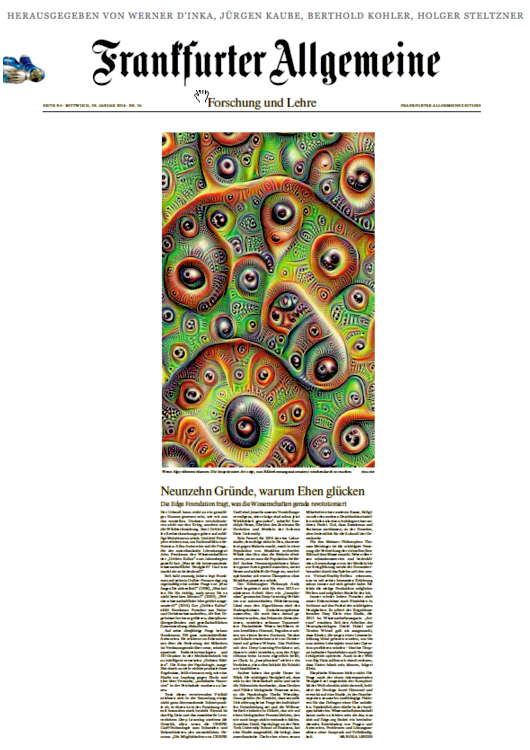
The big bang may not have been such a huge thud, as we imagine. Drones revolutionize not only the war, but also the research on wild animals. Two-thirds of all cancers are due to random mutations. And three principles are sufficient to define rationality. All answers to the question placed before the scientists of the "Third Culture" of American literary agent John Brockman: "What is the most interesting scientific news? And what makes them so important?"

For almost twenty years Brockman puts on his online forum edge.org [6] regularly such a question: "What do you think is right, even if you can not prove it?" (2005), "What do you ask yourself?" (1998), "What is the scientific idea is ready for retirement?" (2014). For "Third Culture" is one of Brockman researchers from natural sciences and humanities, discuss their findings in a larger, multi-disciplinary and social context.

In his this year's question Brockman got 198 very different answers. They range from knowledge about the importance of microbes in the digestive tract of new, resource-saving battery technologies and 3D printers in the medical technology to intelligently networked "green cities". The crisis of psychology, triggered by too many non-reproducible results, just missing a little like a study for vaccination against Ebola and one of the testing, "autistic neurons" to grow in the petri dish. [Continue... [7]]

Read highlighted contributions from: Randolph Nesse [8], Andy Clark [9], Thalia Wheatley [10], Thomas Metzinger [11], Gary Klein [12], Jared Diamond [13].

  • John Brockman, Editor and Publisher
  • Russell Weinberger, Associate Publisher
  • Nina Stegeman, Associate Editor
 
  • Contact Info:[email protected]
  • In the News
  • Get Edge.org by email
 
Edge.org is a nonprofit private operating foundation under Section 501(c)(3) of the Internal Revenue Code.
Copyright © 2019 By Edge Foundation, Inc All Rights Reserved.


Links:
[1] https://www.edge.org/news/nineteen-reasons-why-marriages-succeed
[2] https://www.edge.org/annual-question/what-do-you-consider-the-most-interesting-recent-scientific-news-what-makes-it
[3] http://www.faz.net/
[4] https://www.edge.org/memberbio/manuela_lenzen
[5] http://bit.ly/1QwQmw1
[6] http://edge.org/
[7] http://www.faz.net/aktuell/feuilleton/debatten/edge-jahresfrage-wissenschaftliche-revolution-14021572.html
[8] http://edge.org/annual-question/2016/response/26668
[9] http://edge.org/annual-question/2016/response/26635
[10] http://edge.org/annual-question/2016/response/26792
[11] http://edge.org/annual-question/2016/response/26699
[12] http://edge.org/annual-question/2016/response/26692
[13] http://edge.org/annual-question/2016/response/26559