|
|
|
REBOOTING
CIVILIZATION
A Continuing Edge Project Exploring Software, Computation, and the Beginning of Everything |
|
HAUSER, SMOLIN, GREENE, LANIER, POLLACK, GELERNTER, GUTH on "REBOOTING CIVILIZATION: SOFTWARE, COMPUTATION AND THE BEGINNING OF EVERYTHING" [9.10.01] Opening comments and streaming video from the recent Edge meeting .....
EDGE
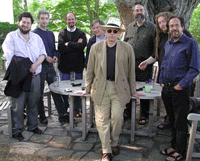
AT EASTOVER FARM: REBOOTING CIVILIZATION
[7.27.01]
One aspect of our culture that is no longer open to question is that the most signigicant developments in the sciences today (i.e. those that affect the lives of everybody on the planet) are about, informed by, or implemented through advances in software and computation. This Edge event is an opportunity for people in various fields such as computer science, cosmology, cognition, evolutionary biology, etc., to begin talking to each other, to become aware of interesting and important work in other fields. SETH LLOYD — HOW FAST, HOW SMALL, AND HOW POWERFUL?: MOORE'S LAW AND THE ULTIMATE LAPTOP [7.23.01] Something
else has happened with computers. What's happened with society is
that we have created these devices, computers, which already can register
and process huge amounts of information, which is a significant fraction
of the amount of information that human beings themselves, as a species,
can process. When I think of all the information being processed there,
all the information being communicated back and forth over the Internet,
or even just all the information that you and I can communicate back
and forth by talking, I start to look at the total amount of information
being processed by human beings — and their artifacts —
we are at a very interesting point of human history, which is at the
stage where our artifacts will soon be processing more information
than we physically will be able to process. SETH
LLOYD is an Associate Professor of Mechanical Engineering at MIT
and a principal investigator at the Research Laboratory of Electronics.
He is also adjunct assistant professor at the Santa Fe Institute.
He works on problems having to do with information and complex systems
from the very small — how do atoms process information, how can
you make them compute, to the very large — how does society process
information? And how can we understand society in terms of its ability
to process information? THE
REALITY CLUB: Joseph
Traub, Jaron Lanier, John McCarthy, Lee Smolin, Philip W. Anderson respond
to Seth Lloyd
JORDAN
POLLACK: SOFTWARE IS A CULTURAL SOLVENT: I work on developing an understanding of biological complexity and how we can create it, because the limits of software engineering have been clear now for two decades. The biggest programs anyone can build are about ten million lines of code. A real biological object — a creature, an ecosystem, a brain — is something with the same complexity as ten billion lines of code. And how do we get there?
JORDAN
POLLACK, is a computer science and complex systems professor
at Brandeis University. His laboratory's work on AI, Artificial
Life, Neural Networks, Evolution, Dynamical Systems, Games,
Robotics, Machine Learning, and Educational Technology has been
reported on by the New York Times, Time, Science, NPR,
Slashdot.org and many other media sources worldwide. Pollack
is a prolific inventor, advises several startup companies and
incubators, and in his spare time runs Thin Mail, an Internet
based service designed to increase the usefulness of wireless
email. FREEMAN DYSON: IS LIFE ANALOG OR DIGITAL [3.14..01] Silicon-based life and dust-based life are fiction and not fact. I use them as examples to illustrate an abstract argument. The examples are taken from science-fiction but the abstract argument is rigorous science. The abstract concepts are valid, whether or not the examples are real. The concepts are digital-life and analog-life. The concepts are based on a broad definition of life. For the purposes of this discussion, life is defined as a material system that can acquire, store, process, and use information to organize its activities. In this broad view, the essence of life is information, but information is not synonymous with life. To be alive, a system must not only hold information but process and use it. It is the active use of information, and not the passive storage, that constitutes life. FREEMAN DYSON is professor of physics at the Institute for Advanced Study, in Princeton. His professional interests are in mathematics and astronomy. Among his many books are Disturbing The Universe, Infinite In All Directions Origins Of Life, From Eros To Gaia, Imagined Worlds, and The Sun, The Genome, And The Internet. THE REALITY CLUB: George Dyson, Cliff Pickover, Joseph Traub, Jaron Lanier, Stewart Brand, William H. Calvin, Marvin Minsky, Charles Simonyi, Stewart Brand, Kevin Kelly, Lee Smolin, Philip W. Anderson, Marc D. Hauser, Jordan B. Pollack, Nicholas Humphrey, Steve Grand, W. Daniel Hillis, Marvin Minsky, John McCarthy, Jaron Lanier, John Baez, Terrence Sejnowski. Freeman Dyson responds. ANDY CLARK: NATURAL BORN CYBORGS? [12.29.00] We
cannot see ourselves aright until we see ourselves as nature's
very own cyborgs: cognitive hybrids who repeatedly occupy regions
of design space radically different from those of our biological
forbears. The hard task, of course, is now to transform all this
from (mere) impressionistic sketch into a balanced scientific
account of the extended mind.
DAVID DEUTSCH: IT'S A MUCH BIGGER THING THAN IT LOOKS [11.20.00] However
useful the theory [of quantum computation] as such is today
and however spectacular the practical applications may be in
the distant future, the really important thing is the philosophical
implications — epistemological and metaphysical —
and the implications for theoretical physics itself. One of
the most important implications from my point of view is one
that we get before we even build the first qubit [quantum bit].
The very structure of the theory already forces upon us a view
of physical reality as a multiverse. Whether you call this the
multiverse or 'parallel universes' or 'parallel histories',
or 'many histories', or 'many minds' — there are now half
a dozen or more variants of this idea — what the theory
of quantum computation does is force us to revise our explanatory
theories of the world, to recognize that it is a much bigger
thing than it looks. I'm trying to say this in a way that is
independent of 'interpretation': it's a much bigger thing than
it looks.
DAVID
DEUTSCH'S research in quantum physics has been influential
and highly acclaimed. His papers on quantum computation laid
the foundations for that field, breaking new ground in the theory
of computation as well as physics, and have triggered an explosion
of research efforts worldwide. His work has revealed the importance
of quantum effects in the physics of time travel, and he is
an authority on the theory of parallel universes.
Born in Haifa, Israel, David Deutsch was educated at Cambridge and Oxford universities. After several years at the University of Texas at Austin, he returned to Oxford, where he now lives and works. He is a member of the Centre for Quantum Computation at the Clarendon Laboratory, Oxford University. He is the author of The Fabric Of Reality. JARON LANIER: ONE-HALF A MANIFESTO [9.25.00] & [11.11.00] For the last twenty years, I have found myself on the inside of a revolution, but on the outside of its resplendent dogma. Now that the revolution has not only hit the mainstream, but bludgeoned it into submission by taking over the economy, it's probably time for me to cry out my dissent more loudly than I have before.
JARON LANIER, a computer scientist and musician, is a pioneer of virtual reality, and founder and former CEO of VPL. He is currently the lead scientist for the National Tele-Immersion Initiative. REALITY CLUB, Part I: [9.25.00] George Dyson, Freeman Dyson. Cliff Barney, Bruce Sterling, Rod Brooks, Henry Warwick, Kevin Kelly, Margaret Wertheim, John Baez, Lee Smolin, Stewart Brand, Rod Brooks, Lee Smolin, Daniel C. Dennett, Philip W. Anderson. REALITY CLUB, Part II [11.11.00] Jaron Lanier responds to comments on the .5 Manifesto from George Dyson, Freeman Dyson. Cliff Barney, Bruce Sterling, Rod Brooks, Henry Warwick, Kevin Kelly, Margaret Wertheim, John Baez, Lee Smolin, Stewart Brand, Rod Brooks, Lee Smolin, Daniel C. Dennett, Philip W. Anderson: Lanier's postscript on Ray Kurtzweil HANS MORAVEC: RIPPLES & PUDDLES [7.26.00] Like little ripples on the surface of a deep, turbulent pool, calculation and other kinds of procedural thought are possible only when the turbulence is quelled. Humans achieve quiescence imperfectly by intense concentration. Much easier to discard the pesky abyss altogether: ripples are safer in a shallow pan. Numbers are better manipulated as calculus stones or abacus beads than in human memory.
HANS MORAVEC is a Principal Research Scientist in the Robotics Institute of Carnegie Mellon University and the author of Mind Children: The Future of Robot and Human Intelligence, and Robot: Mere Machine to Transcendent Mind. REALITY
CLUB: Cliiford
Pickover, Andy Clark, Ben Goertzel, Pamela McCorduck
DAVID GELERNTER: THE SECOND COMING — A MANIFESTO [6.15.00] Everything is up for grabs. Everything will change. There is a magnificent sweep of intellectual landscape right in front of us.
DAVID GELERNTER, Professor of Computer Science at Yale University and adjunct fellow at the Manhattan Institute, is a leading figure in the third generation of Artificial Intelligence scientists, known for his programming language called "Linda" that made it possible to link computers together to work on a single problem. He has since emerged as one of the seminal thinkers in the field known as parallel, or distributed, computing. He is the author of Mirror Worlds, The Muse in the Machine, 1939: The Lost World of the Fair, and Drawiing a Life: Surviving the Unabomber. THE REALITY CLUB: Stewart Brand, David Ditzel, John C. Dvorak, Freeman Dyson, George Dyson, Douglas Rushkoff, Rod Brooks, Lee Smolin, Jaron Lanier, David Farber, Danny Hillis, Vinod Khosla, John McCarthy on "The Second Coming - A Manifesto" by David Gelernter RODNEY
BROOKS: THE DEEP QUESTION [11.19.97]
RODNEY A. BROOKS is Director of the MIT Artificial Intelligence Laboratory, and Fujitsu Professor of Computer Science. He is also Chairman and Chief Technical Officer of IS Robotics, an 85 person robotics company. Dr. Brooks also appeared as one of the four principals in the Errol Morris movie "Fast, Cheap, and Out of Control" (named after one of his papers in the Journal of the British Interplanetary Society) in 1997 (one of Roger Ebert's 10 best films of the year). THE REALITY CLUB: Probert Provine, Douglas Rushkoff, Margaret Wertheim STEVEN PINKER: ORGANS OF COMPUTATION [1.3.97] I see the mind as an exquisitely engineered device - not literally engineered, of course, but designed by the mimic of engineering that we see in nature, natural selection. That's what "engineered" animals' bodies to accomplish improbable feats, like flying and swimming and running, and it is surely what "engineered" the mind to accomplish its improbable feat.
STEVEN
PINKER is professor in the Department of Brain and Cognitive
Sciences at MIT; director of the McDonnell-Pew Center for Cognitive
Neuroscience at MIT; author of Language
Learnability and Language Development (1984), Learnability
and Cognition (1989), The
Language Instinct
(1994), How
the Mind Works (1997), and Words
and Rules (1999).
THE REALITY CLUB: Steven Mithen, Steven Quartz, Nicholas Humphrey, Steven Pinker, Nicholas Humphrey, Rick Potts, David Lykken, Steven Pinker |
|
John Brockman, Editor and Publisher Copyright © 2001 by Edge Foundation, Inc |
|
|Top|
|



 Seth Lloyd on EdgeVideo