
"I can answer the question, but am I bright enough to ask it?"
— James Lee Byars, founder, The World Question Center

"Fantastically stimulating...It's like the crack cocaine of the thinking world.... Once you start, you can't stop thinking about that question." — BBC Radio 4
|
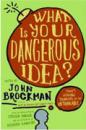
The Edge Annual Question — 2006 WHAT IS YOUR DANGEROUS IDEA? The history of science is replete with discoveries that were considered socially, morally, or emotionally dangerous in their time; the Copernican and Darwinian revolutions are the most obvious. What is your dangerous idea? An idea you think about (not necessarily one you originated) that is dangerous not because it is assumed to be false, but because it might be true? |
[Thanks to Steven Pinker for suggesting the Edge Annual Question — 2006.]
January 1, 2006
Something radically new is in the air: new ways of understanding physical systems, new ways of thinking about thinking that call into question many of our basic assumptions. A realistic biology of the mind, advances in evolutionary biology, physics, information technology, genetics, neurobiology, psychology, engineering, the chemistry of materials: all are questions of critical importance with respect to what it means to be human. For the first time, we have the tools and the will to undertake the scientific study of human nature.
What you will find emerging out of the 119 original essays in the 75,000 word document written in response to the 2006 Edge Question — "What is your dangerous idea?" — are indications of a new natural philosophy, founded on the realization of the import of complexity, of evolution. Very complex systems — whether organisms, brains, the biosphere, or the universe itself — were not constructed by design; all have evolved. There is a new set of metaphors to describe ourselves, our minds, the universe, and all of the things we know in it.
Welcome to Edge. Welcome to "dangerous ideas". Happy New Year.
Publisher & Editor
| CONTRIBUTOR INDEX | COMPLETE TEXT OF RESPONSES |

|
|

|
Most of the contributors appear to have interpreted "dangerous" as meaning something like "subversive," challenging to one or another received orthodoxy. ... In that spirit, here is my dangerous idea: Every child in school deserves an individual IQ test. ... And the corollary: Every statistical analysis of school- and district-level data should include individual IQ as one of the variables measured. ... Why is that subversive? Because so many people, especially in education, are terrified to admit that individual IQ has anything to do with academic achievement, because it is not evenly distributed demographically. |

 Meine gefährlichste Idee Ralf Grötker 04.01.2006 172 Wissenschaftler antworteten auf die Edge-Frage 2006 Seit nunmehr neun Jahren startet die Stiftung Edge mit einer Umfrage zu einem großen generellen Thema ins neue Jahr. 172 Wissenschaftler haben diesmal geantwortet. Sie geben preis, was sie für ihre gefährlichste Idee halten, die wahr werden könnte. |
|
La afirmación políticamente más incorrecta, a cuyo autor pueden acusarlo de racista si no de nazi, es que hay grupos humanos cuyas características genéticas los hacen más inteligentes que otros. Lo malo es que esto lo afirman algunos científicos al contestar a la pregunta que hace cada año The Edge (www.edge.org), órgano de un club de sabios de todo el planeta que se plantean problemas aparentemente simples que son comple- jísimos. La cuestión de 2006, que responderán hasta 2007 miles de investigadores, la presentó Steven Pinker, psicolingüista, profesor de psicología en Harvard. Recuerda Pinker que la historia de la ciencia está repleta de descubrimientos que fueron considerados social, moral y emocionalmente peligrosos; los más obvios, la revolución copernicana y la darwiniana. |

|
With the aim of gathering ideas from the world's leading thinkers on intellectual, philosophical, artistic and literary issues, US writer John Brockman established The Edge Foundation in 1988. Since 1997, Edge has been running on the Internet (www.edge.org), and every year poses a question in its The World Question Centre. |

|
Royal Society president Martin Rees said the most dangerous idea was public concern that science and technology were running out of control. "Almost any scientific discovery has a potential for evil as well as for good; its applications can be channelled either way, depending on our personal and political choices; we can't accept the benefits without also confronting the risks. The decisions that we make, individually and collectively, will determine whether the outcomes of 21st century sciences are benign or devastating." Professor Rees argues that the feeling of fatalism will get in the way of properly regulating how science progresses. "The future will best be safeguarded — and science has the best chance of being applied optimally — through the efforts of people who are less fatalistic." |

|
AUDACIOUS KNOWLEDGE |

|
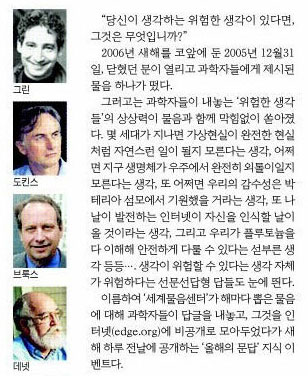
The results (collected at www.edge.org) give an insight into how philosophically minded scientists are thinking: the result is somewhere between a multi-disciplinary seminar and elevated high table talk. The responses to Brockman's question do not directly engage with each other, but they do worry away at a core set of themes. Many agree that neuroscience at the micro level and evolutionary psychology at the macro level have abolished free will. Richard Dawkins is typical: "Assigning blame and responsibility is an aspect of the useful fiction of intentional agents that we construct in our brains as a means of short-cutting a truer analysis of what is going on in the world." Holding people responsible for their behaviour is, in his view, completely irrational. |

|
Theories of social nets and their relationship with the contemporary sociology, dangerous ideas of scientists on Radio3 Scienza on Radio3. [click here: |


|
Forget for a moment the substance of the arguments in defense of Darwin, Intelligent Design and the Bible. These arguments will take care of themselves in real time, by the clock and according to the calendar. No one proves or disproves any of the theories about the origin of our planet. But how we choose to conduct these debates, the knowledge we bring to the argument, is crucially important. Intellectual revolutions have a way of changing how we think. The way we frame the argument, the idols, gods or the God we celebrate, ultimately informs politics and dictates policy. You could visit a provocative cyber salon known as The Edge (www.edge.org) to test yourself against the edgiest thinking on these subjects. John Brockman, who likes being described as a "cultural impresario," poses a question every year that would tempt an answer from Dr. Faustus. This year he asks contributors for "dangerous ideas." "The history of science is replete with discoveries that were considered socially, morally, or emotionally dangerous in their time; the Copernican and Darwinian revolutions are the most obvious," he writes. "What is your dangerous idea? An idea you think about (not necessarily one you originated) that is dangerous not because it is assumed to be false, but because it might be true?" |

|
Academics see gene cloning perils, untamed global warming and personality-changing drugs as presenting the gravest dangers for the future of civilization ...Richard Dawkins, of Oxford University, said our increased understanding of how our brains work would lead to difficult questions in defining morality. "As scientists, we believe that human brains, though they may not work in the same way as man-made computers, are as surely governed by the laws of physics," Dawkins said. "When a computer malfunctions, we do not punish it. We track down the problem and fix it, usually by replacing a damaged component, either in hardware or software. Isn't the murderer or the rapist just a machine with a defective component? Or a defective upbringing? Defective education? Defective genes?" he said. ... |


 Sunday, January 8, 2006 Sunday, January 8, 2006READING FILE Edge.org canvassed scientists for their "most dangerous idea." David Buss, a psychologist at the University of Texas, chose "The Evolution of Evil." The dangerous idea is that all of us contain within our large brains adaptations whose functions are to commit despicable atrocities against our fellow humans — atrocities most would label evil. The unfortunate fact is that killing has proved to be an effective solution to an array of adaptive problems in the ruthless evolutionary games of survival and reproductive competition: Preventing injury, rape, or death; protecting one's children; eliminating a crucial antagonist; acquiring a rival's resources; securing sexual access to a competitor's mate; preventing an interloper from appropriating one's own mate; and protecting vital resources needed for reproduction. ... The danger comes from people who refuse to recognize that there are dark sides of human nature that cannot be wished away by attributing them to the modern ills of culture, poverty, pathology, or exposure to media violence. |
|
Arts & Entertainment Each Christmas, the Manhattan literary agent John Brockman gives his pals a "riddle me this." A year ago he brain-teased: "What do you believe is true even though you cannot prove it?" And this time: "What is your dangerous idea?" Brockman's challenge is noteworthy because his buddies include many of the world's greatest scientists: Freeman Dyson, David Gelertner, J. Craig Venter, Jared Diamond, Brian Greene. Yet their ideas, delineated in brief and engaging essays, are not just for tech-heads. The 119 responses Brockman received to the most recent question -- posted at www.edge.org -- are dangerous precisely because they so often stray from the land of test tubes and chalkboards into the realms of morality, religion and philosophy. ... |


|
"The danger rests with what we already know: that we are not all created equal." Genome sequencing pioneer Craig Venter suggests greater understanding of how genes influence characteristics such as personality, intelligence and athletic capability could lead to conflict in society (Edge.org magazine, 1 January) |

|
The wilder shores of creativity He asked his roster of thinkers - V.S. Ramachandran, Paul Davies, Daniel Dennett, Jared Diamond, Daniel Goleman, Matt Ridley, Simon Baron-Cohen, Mihaly Csikszentmihalyi and Martin Seligman, among the most famous - to nominate an idea, not necessarily their own, they consider dangerous not because it is false, but because it might be true. Two ideas with enormous ramifications for the arts resonated though the tens of thousands of words of text. ... |

 January 5, 2006 FROM CLONING TO PREDETERMINATION OF SEX: THE ANSWERS OF INVESITGATORS AND PHILOSOPHERS TO A QUESTION ON THE ONLINE SALON EDGE Scientists discuss dangerous ideas By Giovanna Zucconi Per quanto spaventevole e surreale possa apparire l'idea di ventiquattrore senza connessione alcuna, se non con i propri pensieri o con la mancanza dei suddetti, considerare la solitudine addirittura una minaccia per l'umanità così come la conosciamo sembrerebbe una provocazione. E infatti lo è. Sul filo del paradosso, così ha risposto il neurobiologo californiano Leo Chalupa alla domanda posta dalla rivista Edge: qual è, secondo lei, l'idea più pericolosa oggi in circolazione? Pericolosa non perché è falsa, ma perché potrebbe rivelarsi vera? Chalupa argomenta appunto che l'iper-informazione che ci bombarda è una forma di totalitarismo, serve a intasare l'attività neuronale, cioè a impedirci di pensare. E che un'intera giornata di solitudine sarebbe perciò eversiva: molti, pensando e ripensando, metterebbero in discussione la società in cui viviamo. ... |


|
|


|
|



|
Gene discoveries highlight dangers facing society
Craig Venter, founder of the J Craig Venter Science Foundation, said the genetic basis of personality and behaviour would cause conflicts in society. He said it was inevitable that strong genetic components would be discovered at the root of many more human characteristics such as personality type, language capability, intelligence, quality of memory and athletic ability. "The danger rests with what we already know: that we are not all created equal," he said. |

 Mankind's increasing understanding of the way genes influence behaviour and the issue's potential to cause ethical and moral dilemmas is one of the biggest dangers facing society, according to leading scientists. The concerns were voiced as part of an exercise by the web magazine Edge, which asked more than 100 scientists and philosophers: "What is your dangerous idea?". The responses were published online yesterday.

SCIENCE NOEBOOK • THERE IS ONE dangerous idea that still trumps them all: the notion that, as Steven Pinker describes it, “groups of people may differ genetically in their average talents and temperaments”. For “groups of people”, read “races”. |
|
The Earth can cope with global warming, schools should be banned and we should learn to love bacteria. These are among the dangerous ideas revealed by a poll of leading thinkers. ohn Brockman, the New York-based literary agent and publisher of The Edge website posed the question: what is your dangerous idea? in reference to a controversial book by the philosopher Daniel Dennett that argued that Darwinism was a universal acid that ate through virtually all traditional beliefs. Brockman received 116 responses to his challenge from Nobel laureates, futurists and creative thinkers. ... |

|
Science can be a risky game, as Galileo learned to his cost. Now John Brockman asks over a hundred thinkers, “What is your most dangerous idea?”... more» |

|
Sunday, January 1, 2006 Here is U.C. Davis neurobiologist Leo M. Chalupa's dangerous idea:
|

|
What you will find emerging out of the 117 essays written in response to the 2006 Edge Question — "What is your dangerous idea?" — are indications of a new natural philosophy, founded on the realization of the import of complexity, of evolution. Very complex systems — whether organisms, brains, the biosphere, or the universe itself — were not constructed by design; all have evolved. There is a new set of metaphors to describe ourselves, our minds, the universe, and all of the things we know in it. |

|