
|
||||||||||||||||
THE
MAKING OF A PHYSICIST:
—JB |
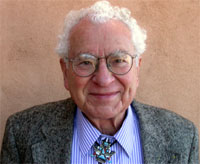

THE MAKING OF A PHYSICIST [MURRAY GELL-MANN:] I was born on Manhattan Island just a few weeks before the great stock market crash and I grew up there, except for a few years in the depths of the Depression, when the situation of my family became especially difficult and we couldn't afford the rents in Manhattan. Not only did the crash herald the beginning of the Depression, but the draconian National Origins Act of 1924 became fully effective in 1929. Both of these developments were bad for my father, because he ran a small language school. A German-speaking immigrant from the Austrian part of Austria-Hungary, he had learned flawless English as a young adult. Is pronunciation and grammar were perfect. You might suspect he was a foreigner only because he never made any mistakes. He tried a number of different jobs and finally achieved some modest success with his language school. Besides teaching English to immigrants, he taught German and he hired other teachers for the Romance languages. However, the combination of the Depression and the dearth of new immigrants ruined his school and we fled from the Gramercy district, where I lived when I was a little child, to the area near the Bronx Zoo. Later on we returned to Manhattan, to the Upper West Side, and I grew up there. My father came to America in the first decade of the 20th century. He was a little over 20 at the time. He had spent a year at the University of Vienna and a year at the University of Heidelberg in Germany. He would have returned to Vienna for the third and final year of his undergraduate work, but his parents had immigrated to the U.S. and were not doing well, so they asked him to come over and help. At the time he knew very little English, but he came to Philadelphia, where he worked in an orphanage and learned English and baseball from the orphans. It's a good thing he came, since if he hadn't he would probably have been killed in the First World War. My mother lived most of her life in New York and believed for a very long time that she was native-born. She voted in four or five presidential elections before she found out that she'd actually come over from Austria-Hungary as a baby. She had to be naturalized in a big hurry in 1940. If she hadn't become a citizen then she would have turned into an enemy alien when the United States joined the war. My mother was very kind and nurturing, but she had somehow lost her ability to deal with anything intellectual. I don't know how that happened. When she was a high school student she had extremely good grades. Her report cards showed that she had done well in algebra and Spanish, but I don't think she could recall a single formula or a single word of Spanish when I knew her. She would have liked to go to college, but her stepfather ruled it out and said she had to work. She went to secretarial school instead and became a secretary. She was a good typist and her spelling and grammar were always excellent. She did a very good job of taking care of the family, and was very loving. She also had the idea that I was a little bit special, and she tried very hard to get me into a private school, although my father had no interest in that whatsoever. I didn't know what was happening, but I kept having to pile blocks on top of one another in various tests at different places in New York City. I realize now, of course, that these were all attempts to get me into a private school with a full scholarship. They all failed, unfortunately, until finally a very nice music teacher named Florence Freint succeeded in getting me into Columbia Grammar School. My brother
Ben was a wonderful influence in my life. He taught me almost everything
I knew when I was little. Ben and I would do all sorts of things
together. He loved bird-watching and we were also interested in
flowering plants, trees, butterflies, and many other things. After
we moved back to Manhattan we still went up to the Bronx for some
of our bird-watching because just north of the Bronx Zoo is the
only remaining stretch of the hemlock forest that once covered
the whole of New York. We regarded the city as a hemlock forest
that had been over-logged, and so we spent some of our time in
the small portion of the forest that was still preserved. My father and brother were both interested in how to pronounce the sounds in various languages and we all practiced. Except for German and English we didn't have them exactly right, of course, but we were close. My interest in etymologies and the relationships among languages was stimulated by one of my father's books. When I was a little child and we moved to a tiny apartment, he had to give away his library, which beforehand was very extensive. He kept a few books, though, and one of them was on Greek and Latin roots in English. That subject really fascinated me, and I never ceased being absorbed by the relationships among languages. I'm now involved, with a number of linguists, in a project I helped to organize to explore very distant relationships among human languages. Many of the established holders of chairs in historical linguistics don't believe in investigating these distant relationships, but I strongly disagree with them. They recognize families of languages that go back something like six thousand years, for example Indo-European, Uralic, and Austronesian, but in most cases they refuse to consider larger families (I call them "superfamilies") that go back much further in time. If they were right, then the evidence for the families they do acknowledge would be marginal, but in fact that evidence is overwhelming, and therefore it makes sense to go back further and explore superfamilies. Since the evidence for those larger groupings is naturally scarcer than it is for closer relationships, we have to be as careful and as scientific as possible.My brother was almost nine years old when I was born and, like me, was three years ahead of most other students in his school. He graduated from high school at the age of 14 and went on to City College in New York, but didn't like it very much. He wanted to spend more of his time bird-watching, so he didn't attend classes regularly and at the age of 15 became what we now call a college drop-out. This was not very common in the 1930s, and certainly not at the age of 15. He became interested in photography, and curiously enough I played a role in that, although I've never had anything to do with photography since then. I entered Columbia Grammar School when we moved back to Manhattan in 1937. We were living on West 93rd Street, almost across the street from the school. CGS had a long history, having been founded in 1764 as part of Kings College, which became Columbia University. I entered on a full scholarship, and at the age of 8 I was put into the sixth grade. The other kids were mostly about 11 — maybe a couple of them were 10. That was the last time that I skipped grades. There have been periods of time when schools didn't believe in skipping, but in the 1930's it was a common practice. I was a student at Columbia Grammar for seven years, from sixth through twelfth grade, and having attended a private school must have helped me later with admission to a good university. When I entered CGS I learned that each student in grades 6-8 was supposed to join a hobby club and then, after six weeks, switch to another club, and so on over the course of the year. I had become very interested in coins — another interest, by the way, that has persisted throughout my life — and I wanted to join the coin club, but it was already filled up, as were some others that attracted me, and so I was forced to join the photography club. I seized on my parents' old Kodak and my brother and I started to use it. We went out into Central Park and learned to take outdoor pictures at an elementary level, developed them in the bathroom under a red light, and fixed prints with "hypo". After six weeks I shifted to the coin club, which had opened up, and never touched a camera again until the age of digital photography. My brother, however, got really interested and became a photographer. He worked at some humble job at a photo studio and then started taking pictures at weddings. He was a photo-intelligence officer in Italy during the war and then returned to New York, where he continued to work as a photographer. Later he moved to Southern Illinois, where his wife was from, and got a job as a news photographer at the Carbondale Southern Illinoisan. He loved writing, though, and very soon he turned into a reporter. From reporter he became the Sunday editor and a columnist. In fact even in retirement he still writes his column. I don't see Ben often enough these days, but when we do see each other we're very close. He lives in Makanda, Illinois, which is just south of Carbondale, where Southern Illinois University is located. (He was a good friends with Bucky Fuller at SIU.) After retirement he worked for the university for some years. As part of that job he wrote some capsule biographies of faculty members there, including my close friend the archaeologist George Gumerman, who is now a vice-president of the Santa Fe Institute.Ben reformed the spelling of our surname and made it just Gelman. He got tired of telling people about the double L, the double N, the hyphen, and the capital M. ~~~ At home the atmosphere was always friendly to science. My father was very devoted to mathematics, physics, and astronomy. He tried to learn advanced physics, particularly general relativity, and was a great admirer of Albert Einstein. He never succeeded in fully understanding general relativity, but he had books on the subject and worked very hard at reading them. I didn't have an inordinate amount of interest in physical science, although I did like astronomy. I was more interested in natural history — birds, butterflies, flowering plants, and trees — as well as in archaeology and linguistics. All these subjects involve complexity, diversity, and evolution, and they depend a good deal on historical accident as well as on fundamental principles. When it came time to apply for admission to Yale University I had to fill out a form that asked, among other things, what my major subject would be if I were admitted. At the time I thought that it was very unlikely that I would end up there. First of all, I would have to get through Yale's very difficult admission process, and second, because my parents couldn't contribute anything at all I would have to receive the one scholarship available that would permit me to attend without supplying any funds whatsoever. Nevertheless I applied and found myself faced with this question. Uncharacteristically, I discussed my application to Yale with my father, who asked, "What were you thinking of putting down?" I said, "Whatever would be appropriate for archaeology or linguistics, or both, because those are the things I'm most enthusiastic about. I'm also interested in natural history and exploration." He said, "You'll starve!" After all, this was 1944 and his experiences with the Depression were still quite fresh in his mind; we were still living in genteel poverty. He could have quit his job as the vault custodian in a bank and taken a position during the war that would have utilized his talents — his skill in mathematics, for example — but he didn't want to take the risk of changing jobs. He felt that after the war he would regret it, so he stayed where he was. This meant that we really didn't have any spare money at all. I asked him, "What would you suggest?" He mentioned engineering, to which I replied, "I'd rather starve. If I designed anything it would fall apart." And sure enough when I took an aptitude test a year later I was advised to take up nearly anything but engineering. Then my father suggested, "Why don't we compromise — on physics?" I pointed out to him that I had taken a course in "physics" in high school which was not only the dullest class I had ever had but also the only one in which I had ever done badly. We memorized the seven kinds of simple machines and then learned little bits about heat, light, electricity, magnetism, wave motion, and mechanics, but without any hint that these things might be related to one another. I couldn't possibly study such a subject. He said, "It'll be very different when you take advanced courses in physics. You'll learn general relativity and quantum mechanics, and those are very, very beautiful." I thought I would please the old man since it didn't really make any difference what I wrote down on this form. If through some miracle I were admitted to Yale and also got that one scholarship that would permit me to attend, I could always change my mind. In the end I was fortunate enough to be admitted and to get that scholarship. When I arrived in New Haven I was too lazy to switch major subjects, so I actually took physics courses, among others. I got hooked on quantum mechanics and relativity, just the way my father had predicted, and I worked on physics for many, many years. Now, at the Santa Fe Institute, I'm encouraged to work on a broad spectrum of fields, so I'm back to archaeology, linguistics, and many other topics along with some physics. ~~~ The
scholarship that made it possible for me to attend Yale was called
the Medill McCormick Scholarship. It provided for everything. I
didn't even have to work at a "bursary job" like just
about everybody else on scholarship. I was a little troubled about
the names on the scholarship, though, because I knew Bertie McCormick
ran the Chicago Tribune and Joseph Medill Patterson ran
the New York Daily News, neither of which was especially
anti-fascist in the days leading up to the war. As a strong opponent
of fascism — after all, the Second World War was still going
on when I got to Yale — I was troubled to know that I was
receiving money from people with those names. ~~~ At Yale
I was very fond of history classes, and I found Professor Dunham's
course on English constitutional history and Hajo Holborn's courses
on German and medieval history very stimulating. Margenau's course didn't confine itself to philosophy of physics. It was really about physics itself, with some mention of philosophy in connection with each topic. I was quite happy to tolerate that much philosophy, and the teaching about physics was spectacular. Margenau by-passed all the fears that people have about learning relatively advanced subjects. I was only a sophomore and some of the students were juniors; we hadn't studied a great deal of theoretical physics. The advanced topics like quantum mechanics and general relativity loomed as difficult obstacles to overcome in the future, but he made everything so easy. We started with Lagrangian and Hamiltonian mechanics, and Margenau began by saying, "I assume you've all studied the calculus of variations."?" We said no. He then asked, "What do your math teachers do in class today? Apparently they don't teach you anything useful, just epsilons and deltas." He was talking about the highly rigorous approach to analysis that's often taken by professional mathematicians. He said, "I'll teach you the calculus of variations today, and then on Thursday and Saturday we'll do Lagrangian mechanics." That's what he did, and it didn't take longer than he said it would. Then we went on to special relativity, and we went through that in a week or so. Next he announced, "We're going to work on general relativity now, but you need to know tensor analysis; I assume you all know tensor analysis." We said no. He replied, "Well, that's a problem. We'll have to do tensor analysis today and Thursday, and then on Saturday we'll take up general relativity." That's the way it went — it was actually just that easy, including the discussion of quantum mechanics. And besides there were also interesting remarks of a philosophical nature — brief, but very instructive. With a few exceptions most of the physics teaching at Yale wasn't very good. One of those exceptions was Henry Margenau's Physics 32b. While I was at Yale I didn't participate much in social life until my last year. I wasn't elected to any senior society, but I was very interested those secret organizations. In fact, I organized one of the break-ins into the Skull and Bones "tomb." I didn't actually carry out the operation, but I made all the necessary arrangements for two other students to do it. By the time they came to get me it was already daylight and nearly time for the janitor to arrive, so I didn't personally inspect the interior. But we learned what was in there, including all the items carefully marked "stolen from" Of course now all that is public information, for example in the comic strip Doonesbury and in a recent book about Skull and Bones. A marker from the grave of Elihu Yale is described as stolen from Wrexham, England." (Actually, Wrexham is in Wales.) Another stolen item is labeled as the skull of the Apache leader Geronimo. It is generally supposed that the Bones man who stole it was Prescott Bush, the father of George H.W. Bush and the grandfather of George W. In June, 1948, I graduated from Yale and prepared to enter graduate school in physics in the fall. The results of my applications were very disappointing. Harvard admitted me but offered no financial aid. Princeton turned me down flat. At Yale, I was admitted to graduate school in mathematics, but not in physics. The one encouraging reply from a physics department came from MIT. I was admitted and offered the job of assistant to a theoretical physics professor named Victor Weisskopf, of whom I had never heard. When I inquired about him, I was told he was a wonderful man and an excellent physicist and that everyone called him by his nickname, Viki. He wrote me a very nice letter saying he hoped I would come to MIT and work with him. I was still discouraged, though, about having to go to MIT, which seemed so grubby compared with the Ivy League. I thought of killing myself (at the age of 18) but soon decided that I could always try MIT and then kill myself later if it was that bad but that I couldn't commit suicide and then try MIT afterwards. The two operations, suicide and going to MIT, didn't commute, as we say in math and physics jargon. When I got to MIT in the fall, I discovered it was actually a very pleasant place, with most agreeable fellow students (including many from the Ivy League), a number of excellent professors, and even the possibility of taking courses at Harvard. Viki was especially congenial and I enjoyed interacting with the group around him as well. He was a remarkable human being. Viki lived to be ninety-four, and I just recently attended the memorial symposium in his honor at MIT — it was an outpouring of love. At that symposium I chatted with Lászl— Tisza — also
known mostly by his nickname, Laci — who is even older than
Viki was. He's nearly 100 now. He taught thermodynamics and statistical
mechanics in a very elegant fashion. ~~~ I
was supposed to start a postdoctoral year at the Institute for
Advanced Study in September 1950, but because of the delay my
year at the Institute began in January 1951. I was 21 at that
time, and I lived in a rooming house just across the street from
Princeton University. Francis Low was at the Institute then,
and he and I became good friends and worked together, which was
a very pleasant experience for me. Our work was quite useful,
but it had a somewhat formal character. In any case it was much
appreciated by theorists like Robert Oppenheimer, the Director,
who liked formalism. If he had been working on something that looked promising, that would have given me a perfectly legitimate reason to talk with him, and I would certainly have done so. But at that time, asking him about his life and his attitudes toward the world and toward physics was not something I felt comfortable doing. Nowadays, I would most likely not let such an opportunity go. It is curious that ordinary people everywhere seem to have chosen Einstein as a symbol of greatness in physical science. I believe it needn't have turned out that way. People could perfectly well have fixed on someone much less distinguished, whereas Einstein really was a great genius in theoretical physics and fully deserved the adulation he received from the public as a scientist. ~~~ Back when I was in graduate school at MIT I had one of several desks in a room next to Viki's office, and my office-mates were changing all the time. They were not all graduate students — many of them already had Ph.D.'s, including "Murph" Goldberger, who had studied with Enrico Fermi at the University of Chicago. He and I became very friendly and talked a great deal about physics and other subjects. He left to go back to Chicago as an assistant professor, and he got me a job as an instructor there after I had been at the Institute for Advanced Study for a while. Frank Yang, who was at the Institute, had had that same job, and I asked him, "How many instructors are there? Do they have to compete with one another for promotion?" He said I would be the only one. Then I asked if there was a good chance for promotion to assistant professor and he told me there was an excellent chance. So even though as an instructorship the job didn't sound like much, it was actually very good indeed, with an extremely light teaching load that allowed me to do research in theoretical elementary particle physics — some of it with Murph — most of the time. I had to teach only one course per quarter. It was at the University of Chicago that I thought up the idea of the quantity called "strangeness" as an explanation for the "strange particles." I was promoted very soon to assistant professor and not long thereafter to associate professor with tenure. I was something like 24 at the time. It's a little hard to specify how long I stayed at Chicago because I was on leave a good deal, for example in the fall of '54 at Columbia University, where I was asked to join the faculty. In the spring of '55 I was back at the Institute for Advanced Study, partly because my fiance was working there. Margaret was an English girl who read classics at Newnham College, Cambridge. Before graduation she went to the employment office at Cambridge and was told, "We have too many arts graduates like you, so we're sending you to the United States." They got her a fellowship at Bryn Mawr, where she spent a year studying archaeology and working in the basement of the University of Pennsylvania Museum, which is a wonderful place for archaeology. She had spent her summer holidays with her friend Lisa Wace and her father, the famous archeologist Alan Wace, digging at Mycenae. In fact Margaret was the one who found the Linear B tablets there. Each student archeologist had a workman named George, and her George dug up the tablets. Wace had had his career blighted by his correct view that the Greeks had conquered Minoan Crete, and that Mycenaean civilization had been not just a subsidiary one but one with its own important — and Greek — culture. The discovery of the tablets in various places on the Greek mainland, together with Michael Ventris's demonstration that they were written in an early dialect of Greek, helped to confirm Wace's ideas, but that was only after he had been banned from excavation there for many years through the influence of Sir Arthur Evans, who insisted that the Cretans had dominated the mainland as well as Crete. After a year at Bryn Mawr, Margaret had become assistant to an elderly lady archaeologist at the Institute for Advanced Study, where I met her and fell in love at once. The next spring we were married on her birthday, April 19, 1955, and immediately drove out to Caltech. I thought Caltech would be a better place than Chicago to live and to work, and Enrico Fermi, who was an important attraction at Chicago, had died. I had to take the job at Caltech right away, although I had been hoping to spend a year in Denmark at the Bohr Institute. Margaret and I did go to Copenhagen for a few weeks in the summer, but we weren't able to stay. My draft board was very anxious to give me a deferment but I had to be either a student or a teacher. The members of the board didn't understand postdoctoral research fellowships. Another reason for going to Caltech was the prospect of collaboration with Dick Feynman. He, in fact, had arranged for me to be invited to Caltech. He was quite impressed with some of the work I had done. One research project concerned what is now called the renormalization group. Francis Low and I completed that work during the hot summer of 1953 at the University of Illinois. Dick said that this was the only piece of research on quantum electrodynamics that came as a surprise to him. He got quite excited about it and actually extended the results a bit. Interestingly, the renormalization group approach revealed errors in a number of calculations that people had made previously. Years later, my student Ken Wilson applied renormalization group ideas to condensed matter physics, in brilliant research that won him an unshared Nobel Prize .Another discovery that impressed Dick concerned the neutral kaon situation, in which there are two states. One linear combination of those states is involved in the production of the neutral kaon particles, and another linear combination is involved in their disintegration. It's a beautiful example of quantum mechanics at work. Caltech made me a full professor in 1956. I called my father in New York to tell him the news, but he said, "They don't make full professors at your age," and hung up. I suppose he was proud of me, but he wouldn't admit it at that time, only much later. ~~~ By the time I got to Caltech Feynman was very well established. He was eleven and a half years older than I. We worked together for several years, and it was very pleasant and exciting. We would bounce ideas off each other, and call each other at odd times of day and night. We would try things and become enthusiastic about them and then find they didn't work, and sometimes we would find other things that did work; it was quite fun. After a while, however, his preoccupation with himself and his own image began to get on my nerves. He was a very good scientist, but he spent a great deal of effort generating anecdotes about himself. In addition, whenever we did anything together he would somehow think of it as his work. It's not that he didn't appreciate me — he actually admired me a great deal — but somehow he couldn't keep his own ego out of a common effort. Finally I just couldn't collaborate with him any more. We had worked closely together for five or six years and were good friends, but eventually I got turned off. The
effort that Dick spent generating stories about himself was unbelievable.
He insisted on being different, always. His father had taught him
that. However, in many cases it doesn't pay to be different. Doing
the regular thing is often okay. For instance, he advocated on
national television that people not brush their teeth or floss.
We shared the same firm of dentists, and I knew that they were
having terrible trouble with his teeth. They tried to persuade
him to brush, or floss, or both, and he wouldn't do it. They kept
bringing in scientific papers showing that it was useful; but he
kept insisting it was just a superstition. ~~~ One project I worked on at Caltech involved trying to understand the approximate symmetries of the elementary particle system — particularly the hadrons or strongly interacting particles (including the neutron and proton and their brothers and sisters and the pi mesons and their brothers and sisters). I tried various higher symmetry schemes and then finally hit upon what I called the eightfold way, with the group SU(3) as an approximate symmetry. That worked very nicely. At the time I was interested in India and in the various religious traditions of India — not that I would embrace any religion — my interest was merely academic. I thought it would be a good joke to call the scheme the eightfold way, since the particles tended in many cases to come in sets of eight. Some silly people wrote books trying to connect my work on particle physics with oriental mysticism, whereas the connection was only a joke. The crowning triumph of the eightfold way was the discovery in 1964 of the omega-minus particle that I had predicted in 1962 at a meeting in Geneva. On the day of the experimental discovery, my first paper on quarks was published, which laid the foundation for understanding the eightfold way and much else. |
 |
Nearly impossible to put down: engaging original essays from brilliant young scientists on their work — and its fascinating social, ethical, and philosophical implications. The Barnes & Noble Review Long List The engrossing essay collection which offers a youthful spin on some of the most pressing scientific issues of today—and tomorrow...Kinda scary? Yes! Super smart and interesting? Definitely. — The Observer's Very Short List "A captivating collection of essays ... a medley of big ideas." — Amanda Gefter, New Scientist "The perfect collection for people who like to stay up on recent scientific research but haven't the time or expertise to go to the original sources." — Playback.stl.com "[An] engaging book. Perhaps the world started with a bang, but if the scientists who contributed to "What's Next?" have anything to do with it, it will certainly not end with a whimper." — Washington Times WHAT'S NEXT?
If these authors are the future of science, then the science of the future will be one exciting ride! Find out what the best minds of the new generation are thinking before the Nobel Committee does. A fascinating chronicle of the big, new ideas that are keeping young scientists up at night. — Daniel Gilbert, author of Stumbling on Happiness "A preview of the ideas you're going to be reading about in ten years." — Steven Pinker, author of The Stuff of Thought "Brockman has a nose for talent." — Nassim Nicholas Taleb, author The Black Swan "Capaciously accessible, these writings project a curiosity to which followers of science news will gravitate." — Booklist |
||
|



John Brockman, Editor and Publisher |
|Top| |